A következő címkéjű bejegyzések mutatása: English Articles. Összes bejegyzés megjelenítése

2025. szeptember 14., vasárnap

The 1951 Spring Offensive, Part 2. (中国春季攻势 / 第五次战役 )


SPRING OFFENSIVE: FROM YALU TO SEOUL

    China truly shocked the United Nations Command when it launched its first major offensive across the southern border in November 1950. By early December, PVA troops had pushed the front line back to the 38th parallel, while also recapturing the communist capital, Pyongyang, from American/South Korean forces. By January 1951, the third campaign had pushed the United Nations forces back to the 37th parallel, while Chinese troops also captured Seoul, the southern capital. Chinese morale was sky-high, the strategies employed so far had been successful, and the goal of finally driving UN forces out of the Korean peninsula seemed entirely realistic at this point. By the end of January 1951, the fourth Chinese offensive had begun, and by the end of it (spring 1951), the number of Chinese soldiers serving in Korea had reached 950,000, including 42 infantry divisions, 8 artillery divisions, 4 air defense divisions, and 4 tank divisions.


PVA soldiers crossing the Yalu

    These first four Chinese offensives shaped and laid the foundations for the Fifth Campaign, also known as the Spring Offensive. In this chapter, we will examine the military plans employed by the PVA and their preparation, organizational structure and execution, tactical decisions, communication, the resolution of problematic situations that arose during combat, and the performance of the Chinese Volunteer Army. The tactics initially employed were derived from the civil war years, in which massive waves of human waves were used against well-entrenched (and otherwise highly effective) nationalist forces. In the Korean War, the PVA used the same tactics against UN forces: mass assaults, flanking attacks, night raids, close combat, and complete encirclement to counter the extremely threatening artillery power of the UN forces (and their own almost complete lack thereof).

THE CHAIN OF COMMAND

    The PVA chain of command was established in October 1950 and remained in place throughout the Korean War, with Mao exercising operational control from Beijing. At the center of military operations, Mao made strategic decisions and campaign plans through telegrams sent to the PVA headquarters. Peng Dehuai and his staff carried out Mao's plans by tailoring individual operations, organizing forces, and executing battle plans, then sending daily reports to Mao on events at the front lines.


Mao and Peng

    Peng issued detailed instructions to army commanders, and later, during the Spring Campaign, direct communication was established between the PVA headquarters and army commanders. When army commanders later ordered their divisions to carry out missions, the new chain of command did not really work in practice because it proved to be more personality-driven. During the Spring Campaign in the spring of 1951, there were several instances where a commander lost contact with his superior and the chain of command was broken. The relationship between Mao and Peng was not exactly smooth, and this unfortunately left its mark on various military operations: despite receiving Peng's reports and plans every day, Mao constantly and often suddenly changed or modified Peng's plans, naturally at the expense of the Korean PVA command. Peng's approach to the Korean War as a whole was decidedly cautious and conservative compared to Mao's, and arguably more realistic. Mao, placing political doctrine above strategic realities, forced Peng to launch one offensive after another against UN forces. Despite Mao's more than twenty years of experience in planning battlefield campaigns, his instructions to Peng allowed very little independent initiative on the part of the PVA command, which later came back to haunt him.

    Although Mao dominated operational planning and took his role as commander-in-chief seriously, the PLA and PVA never adopted a command and control doctrine that met the requirements of modern warfare. Among Chinese officers, the command transmission system continued to operate through direct personal contacts rather than through official paperwork or other means, which significantly impaired the transmission of orders and the quality of their literal preservation. Within the PLA, personal relationships between commanders were very important, and Peng became frustrated every time he tried to implement Mao's unrealistic plans without the close supervision and personal support of army group and army commanders.

THE FIRST ENCOUNTER

    From October 25 to November 7, 1950, Chinese forces attacked UN forces with continuous raids instead of the defensive campaign planned by Mao and Peng. Mao's plan was based on the assumption that the North Korean People's Army would be able to defend Pyongyang and slow down the UN forces' advance northward. At that time, the North Korean People's Army (NKPA) hereinafter referred to as the NKPA) had a total of 250,000 men, including nine infantry divisions and one tank division in North Korea, nine divisions undergoing training in Manchuria, and the remnants of nine infantry divisions in South Korea. Establishing effective defenses in the areas controlled by the NKPA would have allowed the PVA to gain an advantage and gain a foothold in North Korea to stop the UN forces' northward advance. Attacking enemy forces or launching any kind of offensive campaign was never the main goal of either Mao or Peng, but during his meeting with Kim Il-sung on October 21, Peng Dehuai realized that Chinese intelligence was anything but accurate, with messages arriving at least two or three days late, which made it impossible for him to carry out Mao's plan to defend the 40th parallel.


PVA soldiers in October 1950, during the capture of Seoul

    By this time, UN forces had advanced so far north that on October 19, the NKPA was driven out of Pyongyang and the entire communist defense collapsed in North Korea. Kim Il-sung was able to maintain communication with roughly 50,000 NKPA soldiers, making it impossible for Chinese divisions to complete their assigned task of occupying their defensive positions 193-290 km south of the Yalu River in time. However, the Chinese were helped by the fact that they successfully outmaneuvered American reconnaissance, so the UN forces had no idea that approximately 300,000 PVA soldiers had remained effectively hidden in North Korea for two weeks. This made Mao eager for blood, and he quickly changed his defensive strategy to an offensive one, based on the idea that the element of surprise would allow them to significantly weaken the American/South Korean forces before they could bring in further reinforcements. 

    The First Campaign launched by the PVA, which lasted from October 25 to November 7, 1950, was poorly planned, as UN forces moved much faster and reached much further north than the Chinese had anticipated. The four Chinese armies fought frontal battles with the Republic of Korea's 1st, 6th, and 8th Divisions and the US 1st Cavalry Division. During the first campaign, the PVA command concentrated 120,000-150,000 men in the area north of the Chongcheon-gang River, facing 50,000 UN troops, giving the Chinese a three-to-one numerical advantage. The PVA used combat tactics perfected by the PLA during the Chinese Civil War, such as surprise attacks, roadblocks to separate enemy units, and night attacks to compensate for the overwhelming small arms and artillery firepower of the UN forces. Nevertheless, the PVA failed to achieve its goal of eliminating at least two ROK divisions during the campaign.

    The first encounter with the Americans was purely coincidental, when the Chinese 39th Army attacked Unson, believing it to be defended by South Korean forces. The Chinese only realized from the silhouettes unfolding before them that they were about to face American forces, but they were completely unprepared for the Chinese appearance: many believed that South Korean reinforcements were arriving, and so they tried to shake hands with the approaching Chinese. In the battle that lasted from November 1 to 4, the US 6th Cavalry Regiment and the Republic of Korea 12th Regiment of the 1st Division were decimated, suffering 2,000 casualties by the end of the battle.


American soldiers after the battle of Unson

    The first large-scale clash did not take long to materialize. On November 27, 1950, 120,000 Chinese soldiers stormed the American forces stationed at the Chosin Reservoir. Despite the fact that the Americans put up a fierce resistance and fought back with everything they had, by December 2, Sihung-ni had fallen, bringing the battle for the reservoir to an end. I have already written about the battle for the Chosin Reservoir in a two-part article. If you are interested in more details, you can find them at the following links:

1. cikk: https://ghostdivision74h.blogspot.com/2025/02/battle-for-chosin-reservoir-part-1.html
2. cikk: https://ghostdivision74h.blogspot.com/2025/03/battle-for-chosin-reservoir-finale.html

    After the Battle of Chosin, the Chinese leadership was elated, and despite their heavy losses (and the fact that the American X Corps had managed to escape), they considered the battle and the first campaign a victory.

They were all ready for the next major offensive.

The source I used for this article: Xiaobing Li: China's Battle for Korea 

2025. augusztus 10., vasárnap

ENGLISH New 4th Army / 新四军


    ENG: Actually, I realised during yesterday's photo shoot that there had already been a few sentences on this site about the communist troops who fought against Japan during the war, but it's time to make up for that and present them individually in a shorter article. We will deal with the two main forces, the Eighth Route Army in the north and the New 4th Army in the south, but there were several other guerrilla groups that also fought the Japanese invaders at the time. Although some people in some places will not like the following sentences, objectivity requires certain facts, and since we don't have to answer to anyone in terms of party politics (if we had to, we also wouldn't care), we'll write it down: not all communist troops wanted to fight the Japanese. There are countless accounts in books of them hiding in forests and mountains rather than attacking smaller Japanese garrisons, but there are also examples of them making non-aggression treaties with the enemy in exchange for the safety of the communist's opium fields. There have also been incidents where the Communists have attacked Nationalist garrisons and vice versa, or have given the Japanese the coordinates of Nationalist garrisons, or have attacked Nationalist army positions together with the Japanese from different directions.

    While using a translator into English, check out the link below for a whole series of events from the clashes between the two factions: https://zh.m.wikipedia.org/zh-tw/%E5%9C%8B%E5%85%B1%E6%91%A9%E6%93%A6

    The truth is that the communists were not necessarily unwilling or often unable to take on division-level conflicts the way the NRA did, so the nationalist approach that the communists didn't fight is not true in many places. They did fight, but it is not true to say that they did the lion's share of the fighting and it was thanks to them that China defeated the Japanese, because it was in practice due to the blood sacrifice that the NRA nationalist soldiers made during the 8 years of the war. Nevertheless, it is important to stress that there were indeed communist units within China that took up the gauntlet and, despite their inferior equipment, did their bit in the skirmish!

FOUNDATION:

    The New 4th Army south of the Yangtze River was formed in 1937, as was its "sister group" in the northwest, the Eighth Route Army, and although both were officially under the control of the NRA, in practice Chiang Kai-shek's leadership had little control over what and how the two communist forces would engage in military operations, as both were under the direct control of the CCP (Chinese Communist Party). The N4A's main base was in Anhui, a building that can still be seen in China today. Their supply of military equipment was quite difficult due to the nationalist blockade around their territory, so they had to introduce their own currency, which they kept for 'internal' purchases, while the China-wide currency was used for 'external' purchases (arms, ammunition and anything they could not produce themselves at their bases)

    I won't go into the uniforms, weapons and insignia separately, I have already done that in a combined article earlier. If you missed it, you can read it here:
https://ghostdivision74h.blogspot.com/2023/08/uniforms-of-chinese-communist-armies.html


New 4th Army Youth Organization

    Between 1937 and 1938, the army group headed for Anhui, their main activity being the building of guerrilla bases behind the backs of enemy Japanese forces and the recruitment of recruits. 
Between 1939 and 1940 they continued their base and area development work, clashing with various nationalist guerrilla groups in northern Jiangsu and receiving 12,000 reinforcements from the Eighth Route Army.
By 1940, the conflict between the NRA and the N4A had escalated to the point where it culminated in the Anhui Incident of 1941. This was a large-scale skirmish lasting 6 days, which ended with heavy blood casualties (about 7-8,000 casualties) but with the breakout of the encircled communist troops. Nationalist troops also destroyed the N4A headquarters, after which many N4A soldiers tore off their official blue sky, white sun cap badges and refused to wear them ever again.


1941, Anhui. Not long before the skirmish

    Between 1941 and 1943, the new N4A base was built in northern Jiangsu, by which time the army group had 7 full divisions, totalling 90,000 troops. During this period they were predominantly fighting the Japanese.
Between 1944 and 1945, the Japanese were so short of men in certain areas that they stopped regular attacks on the N4A. Clashes between the communist army group and the nationalist forces then became more frequent again, and the N4A also tried to establish new bases in eastern Zhejiang, Hunan and Hubei. At the end of World War 2, these base-building activities were suspended and they withdrew from these areas. At that time, the New 4th Army numbered roughly 280,000.
The Chinese Civil War resumed in the summer of 1946, and in 1947 the N4A, like the Eighth Route Army, was absorbed into the newly formed People's Liberation Army, and both army groups ceased to exist under their original names.

It is worth highlighting the following battles in which they participated:

- Battle of Luwu
- Battle of Majiayuan
- Defence of Fanchang
- Battle of Huangqiao
- Incident in Southern Anhui
- Battle against Li Changjiang campaign
- Battle of Yanfu and Suzhong
- Fight against "rural cleansing" in central Jiangsu
- The 1943 Huaihai Campaign
- The 1944 offensive of the New Fourth Army
- Battle of South Henan
- 1945 Central China Summer Campaign


EDITOR'S NOTE: New 4th Army members rescued a lot of 88D soldiers who participated in the siege of the Sihang warehouse against the Japanese. These soldiers, after being detained in the concession area, were attempted by the Japanese to be transported to forced labor camps, but many managed to escape, or were ambushed by N4A soldiers in many of their convoys and assisted in their escape. There were 88D soldiers who escaped back to their own army group, but there were also some who continued their military activities in the ranks of the New 4th Army. Source material: the book Eight Hundred Heroes by Stephen Robinson

2025. június 1., vasárnap

The 1951 Spring Offensive, Part 1. (中国春季攻势 / 第五次战役 )


There have not been many articles on the blog lately, due to the fact that I had to get on with the literature for the next project. This time we have come to the next stage of the Korean War, which will take you through the 1951 Spring Offensive from preparation to its conclusion, which came much sooner than the Chinese leadership had originally planned.

The Chinese Spring Offensive took place from 22 to 29 April 1951, which was the most intensive and largest area operation of the entire Korean War. The PVA, together with the NKPA, launched its operation along the entire 38th parallel, deploying some 700,000 men in the aim of destroying 5 full divisions and 2 brigades of the US 1st Corps and retaking Seoul. The rapid successes achieved in the winter of 1950 could not be repeated here by the Chinese, and in this series of articles I will go into these reasons in as much detail as possible, but without giving you a totally dry and boring piece of material.

PREPARATIONS:

In 1950, the PVA was still not operating on the basis of a chain of command and associated doctrines that should have been the foundation of a modern warfare army. The biggest cancer in the chain of command during mobilization for the Korean War (as in other communist armies around the world) was that important positions were filled not by high quality people with expertise and experience, but by those who were put there by their superiors based on personal connections or political party preferences. Commanders liked to work with those they knew best, but for the troops sent south to Manchuria, the Chinese leadership wanted the best commanders to be at the top. Due to transfers and sometimes changes in job titles, a period of chaos ensued for the Chinese divisions stationed in the north and awaiting deployment.

Many contemporary sources also mention that the mobilisation itself was a much easier task than the demobilisation after the end of the Chinese Civil War in 1949, but the arrival of such a large number of recruits in the army presented PLA officers with a new challenge: to provide a sound justification and motivation to the new recruits from simple peasant families as to why they would have to fight on foreign soil against the most modern army in the world, the United States. The CCP leadership used three methods before the Chinese volunteers were sent to fight in Korea:


- First, members of the PVA teams underwent a kind of political training that lasted for 2 months. 50% of the soldiers were declared fit to serve in the conflict, although the majority were civil war veterans or party members, who usually volunteered to join the PVA to fight the Americans and defend their country. It is worth noting here that, however rarely mentioned, the Americans posed a real threat to China, with President Truman even considering the use of the atomic bomb, although this was later abandoned. The deliberate US bombing of Chinese settlements along the border was just the dot on the i which further confirmed to the leaders of the People's Republic of China that they had to act on the Korean situation. 30% of the troops were considered to be an "intermediate element" who would fight if ordered to do so, but apart from that, they did not care whether there was a war or not. The remaining 20% were classed as "of uncertain mental state", the ones who were specifically afraid of going into combat with US forces and called the Yalu River Bridge the Gates of Hell. They believed that getting involved in the Korean War would only be unnecessary interference in the affairs of others, and that involvement would draw unnecessary attention to China from the Americans.

- The second step was the training of soldiers and the modernisation of the technical support that could be given to them. In September 1950, the training of Chinese soldiers was divided into 2 phases:

1. The first phase included small group combat tactics, small arms training, tank and anti-aircraft weapons and the handling of various explosives.


2. The second phase looked at different operational tactics, an area of modern warfare at the time that even veterans of the Civil War found novel. Chinese soldiers who had fought alongside the Americans in Burma as members of the Expeditionary Force were often invited to these exercises, giving their leaders a relatively good idea of the character of the American soldiers and their fighting style.


The NEBDA (North East Border Defense Army) also made a good effort to standardize the firearms used in the PVA to try to eliminate the logistical nightmare that existed at the end of the Civil War (imagine how much fun it was to provide the necessary ammunition for dozens of pistols, rifles, machine guns, machine guns and heavy machine guns, and then I won't even mention the different locally manufactured versions of these weapons. Only the Mauser C96 pistol existed in 4 calibres at the time....). I mentioned this in an earlier article, but let's look at concrete examples of how it looked in practice: by mid-August, for example, all existing small arms in the 38th Army had been replaced by Japanese rifles and machine guns, while almost everyone in the 40th Army was using rifles, machine guns, submachine guns and other equipment looted from the Americans, sometimes from NRA soldiers during the Civil War.


Thanks to the systems implemented above, training was also standardised, so that the efficiency of soldiers in the use of their weapons was increased in the respective army groups. Unfortunately, automatic weapons were still in short supply (and the PLA/PVA did not have a large number of Soviet weapons at that time), so soldiers had to watch which of their comrades with these types of weapons fell in combat in order to pick up the dropped weapon. The effectiveness of the Chinese on the battlefield was quickly demonstrated in the first phase of the Korean War, and training played a key role in the PVA's success on the battlefield. The country's economy was entirely converted to war production, and during the war years the government provided 5.6 million tonnes of supplies to its troops fighting in Korea. Between 1950 and 1953, war spending accounted for 38% of China's total budget, and it was the first time in China's history that its armed forces were deployed in a foreign country.

Although the term "Chinese Volunteer Force" may deceptively convey the impression that only a small number of Chinese troops were deployed in Korea, the reality was that the entire Chinese army was mobilised, and this time they were preparing to take on the world's most modern and best-trained army in Korea.

Source I'm using for the article: Xiaobing Li: China's Battle for Korea

2025. március 15., szombat

Battle for the Chosin reservoir. Finale: the Battle of Funchilin Pass and the evacuation at Hungnam


The battle for the Chosin reservoir ended and resumed with a rather hasty American retreat. After a brief respite, on 6 December 1950, the breakout was launched, led by the 7th Marine Division, to the south (Armchair Historian's previously published video provides a very good visual representation of both US and Chinese troop movements), with the 5th Marine Division forming the rear guard. At the same time, the slightly delayed 26th PVA Corps (76th and 77th Divisions) relieved the 58th and 60th Divisions at Hagaru-ri. While the 7th Marines pushed the 76th PVA Division south of Hagaru-ri, the 5th Marines took over the outskirts of Hagaru-ri and recaptured the East Hill from the 76th. In a last-ditch effort to stop the American breakout, the Chinese launched their usual night attack, with the 76th and 77th divisions attacking American positions on the outskirts of Hagaru-ri from all directions. The Marines successfully repelled the unrelenting Chinese attacks, inflicting heavy casualties.

Meanwhile, the 7th Marine Division successfully opened the Hagaru-ri-Koto-ri pass, occupying the high ground surrounding the road. As soon as the Marines withdrew from this high ground, the Chinese 77th PVA Division returned to the high ground and successfully attacked the American column. Total chaos broke out, serious clashes took place and the retreat slowed. The Marines fought off the Chinese forces in night fighting, and most of the PVA troops blocking the retreat route were eliminated. On 7 December, the last of the column managed to reach Kot'o-ri with some difficulty.


Troop movements of the retreating US forces (blue) and the attacking Chinese forces (red)

After the failure of the Chinese 26th Corps at Hagaru-ri, the PVA General Headquarters sent the 26th and 27th Corps to pursue the fleeing UN forces and the 20th PVA Corps to block the escape route. However, as most of the 20th PVA Corps had been destroyed in the Yudam-ni and Hagaru-ri areas, the only significant Chinese forces between Kot'o-ri and Hungnam were the remnants of the 58th and 60th Divisions. In desperation, Song Shilun ordered these troops to dig in at the Funchilin Pass, while he blew up the only vital bridge in the area (40.232°N 127.296°E), hoping that the terrain and obstacles would allow the 26th and 27th Corps to catch up with the retreating UN forces.


The Watergate bridge on an american made aerial photo


Source for the previous two pictures: https://warfarehistorynetwork.com/article/americans-faced-blown-out-bridge-during-retreat-to-38th-parallel/


American units crossing the freshly repaired bridge

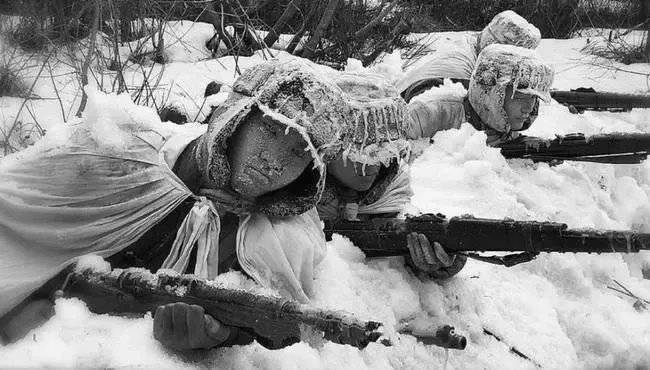
The 180th Regiment of the PVA, which had occupied Hill 1081 (40.233°N 127.326°E), then blew up the original concrete bridge and the two makeshift replacements the Americans had built afterwards in quick succession, and were then under the impression that the bridge had become beyond repair. In response, the 1st Battalion, 1st Marine Division, launched an attack from the south against the Chinese troops dug in on Hill 1081, and the hill was captured on 9 December. It was a bittersweet victory, because the PVA men literally fought to the last bullet and all of them died heroic deaths on Hill 1081.  At the same time, the 7th Marines and RCT-31 launched an attack on the bridge from the north, only to be met by Chinese defenders who froze to the death in their trenches like a group of ice-coiled statues. There were also instances of US Marines finding Chinese units that were still alive but could no longer move, so the Americans pulled them out of their trenches to start to 'thaw' somewhat. It was also common for Chinese soldiers to have their hands so frozen to their weapons that the American soldiers had to break their fingers to take their weapons.

Frozen PVA soldiers in their ambush positions

With the road to Hungnam still blocked at Funchilin Pass, the US 314th Troop Carrier Squadron used eight C-119 aircraft to drop parachute-borne bridge sections. The bridge, which consisted of eight separate sections 5.5 metres long and weighing 1,900 pounds (1,300 kg), was dropped one at a time, using a 15-metre parachute for each section. Four of these sections, along with additional wooden extensions, were successfully assembled by Marine Corps combat engineers and members of the US Army's 58th Engineer Company on 9 December into a replacement bridge, allowing UN forces to continue their advance south. The PVA's 58th and 60th divisions, although at a considerable disadvantage, continued to try to slow the retreat of the UN forces with ambushes and raids, but weeks of non-stop fighting left the two Chinese divisions completely depleted in both materiel and manpower, with only 200 troops remaining. Unfortunately, I have not been able to find exact figures for this (if I can in the near future, I will update this article), but if we take the full deployment (10,000 troops per division) of both PVA divisions in question from the point they crossed the Yalu River (19 October 1950), the total number of troops in each division was about 10,000. ) to the point where the Americans withdraw their last troops at Hungnam (11 December 1950), this represents a 99% loss of troops in practically 3 months..... The last UN forces left Funchilin pass on 11 December 1950.

EVACUATION AT HUNGNAM

The heavy cruiser USS Saint Paul fires its 8-inch (203 mm) guns at Chinese troops threatening evacuation

By the time the UN forces arrived at Hungnam, MacArthur had long since (on 8 December) ordered the evacuation of the US X Corps to reinforce the US Eighth Army, which by then was severely depleted and rapidly retreating towards the 38th parallel. Following his orders, the ROK I Corps, the ROK 1st Marine Regiment and the US 3rd and 7th Infantry Divisions also established defensive positions around the harbour. There were some exchanges of fire between the defending US 7th, 17th and 65th Infantry Regiments and the pursuing Chinese 27th PVA Corps, but against heavy naval gunfire from the US Navy's 90th Marine Corps, the badly battered 9th Corps was no longer in a position to approach Hungnam.

The USS Begor high-speed transport vessel observes the destruction of Hungnam's port facilities on 24 December

In what US historians have called "the largest naval evacuation movement in American military history", an armada of 193 ships gathered in the harbour and managed to evacuate not only the UN troops but also their heavy weapons and about a third of the Korean refugees. One of the Victory ships, the SS Meredith Victory, evacuated 14,000 refugees alone, despite being designed to carry only 12 passengers. The last UN unit left the country at 14:36 on 24 December, and the port was demolished to make it completely unusable by the Chinese. The PVA's 27th Army moved into Hungnam on the morning of 25 December.

CASUALTIES

According to official estimates published by the General Logistics Department of the People's Liberation Army in 1988, the PVA's 9th Army Corps suffered 21,366 casualties, including 7,304 dead. In addition, 30,732 non-combat casualties were attributed to the extremely harsh Korean winter and food shortages. The 9th Corps suffered a total of 52,098 casualties, more than a third of its initial total. Outside of official channels, the estimate of Chinese casualties was put at 60,000 by Patrick C. Roe, chairman of the Chosin Few Historical Commission, citing the 9th Corps' request for supplies after the battle to replenish its personnel. Regardless of the differing estimates, Yan Xue, a historian at the PLA National Defence University, noted that the 9th Corps was completely disabled for three months after the battle at the Chosin Reservoir (until March 1951 to be precise). With the absence of the 9th Corps, the Korean Chinese Army was reduced to 18 infantry divisions by 31 December 1950, compared to 30 infantry divisions present on 16 November 1950.

WINNERS OR LOSERS?

In fact, there are many researchers, many points of view, and many ways of interpreting what happened at the Chosin reservoir. To start with, both sides can claim a victory: the PVA's 9th Corps completely dominated the battlefield, while the X Corps was able to hold off the PVA's 9th Corps in a series of battles, allowing it to use them as effective tactical units to help withdraw a large part of its forces. It can also be seen as a kind of Chinese "geographical victory", because although the PVA did not achieve its goal of destroying the US 1st Marine Division, the X Corps was successfully driven out of North Korea. According to the official Chinese history textbook published by the PLA Military Academy of Sciences, despite the heavy losses, the PVA's 9th Corps earned the victory by successfully defending the eastern flank of Chinese forces in the Korean theatre of operations while inflicting more than 10,000 casualties on United Nations forces.

If we look at the events at the Chosin reservoir from the other point of view, the PVA's 9th Army was defeated because of its heavy losses and its inability to destroy the very understrength US/UN forces: the Chinese were able to deploy approximately 120,000 soldiers during the battle, while the US/UN forces were able to deploy approximately 30,000. Unfortunately, the battle affected the PVA in two ways, both of which had the result of helping the UN Command to stabilise their South Korean position, while at the same time losing North Korea for a time.
- Firstly, according to historian Shu Guang Zhang, the PVA commanders, under the influence of the victories at Chosin and Ch'ongch'on, were lulled into the completely false illusion that they were "capable of completely defeating the US armed forces" and this led to "unrealistic expectations of what miracles the PVA would perform in the future."
- Second, the sub-zero temperatures and heavy casualties caused by the fighting, coupled with poor logistical support, weakened the PVA's eight elite divisions of the 20th and 27th Corps to the point that the leadership was forced to disband two of these eight divisions completely. By early 1951, 12 of the 30 Chinese divisions in Korea were now missing, and heavy Chinese losses at the Chosin Reservoir allowed the UN forces to gain a firm foothold in southern Korea.

As we shall see later, this will have the fateful consequences of creating a kind of stand-off between the parties between July 1951 and July 1953, and from 1951 onwards the Chinese forces will no longer be able to launch counter-attacks as effectively and achieve as much success as they did up to the end of December 1950.

MOVIE RECOMMENDATION:

A Chinese action movie about the Battle of Watergate Bridge at Funchilin Pass has also been made, and this one is in many ways better than the previous Battle of Changjin Lake.....it is the second part of the series, and even if it is not perfect, it is well worth a Sunday afternoon with popcorn and nachos. Below you can watch the trailer:

2025. február 9., vasárnap

Battle for the Chosin Reservoir, Part 1.


If there's one thing that can get me off studying military history from either side, it's the stupid, arrogant or even ignorant attitude of the high command to the combat situation and the resulting high number of soldiers killed. I have written before in articles introducing the Korean War that the sudden Chinese willingness to get involved was problematic at several points, I recommend reading an earlier article of mine in case anyone missed it: https://ghostdivision74h.blogspot.com/2024/01/koreai-haboru-3-hadsereg-allapota-1950.html

Whether or not the Chinese were justified in wanting to participate is open to debate on a number of points, but it is beyond dispute that there were some within the Chinese Communist Party who were completely out of their minds when they took seriously the fact that they were throwing whole divisions into the notoriously harsh Korean winters in thinner winter clothing for Chinese climates. There were, of course, a fair number of soldiers who were sent to Korea in summer clothing. It is clear that the war was sudden and that we had to react quickly, but this kind of attitude is devoid of any common sense. So it was with Commander Song Shilun's 9th Army Corps, who were the first to be thrown across the Yalu River from inside southern China to stop the United Nations forces. As the elite division of the Huaihai campaign during the civil war, the 9th Corps entered Korea with 120,000 troops, having undergone a major resupply, including two full divisions of former Nationalists who had surrendered during the civil war. They were sent into the grinders of the Korean War by the communist leadership, not only because they were tough, but also to ensure that as few of their class enemy elements as possible returned to China. Of course, there was later wonderment as to why the many PVA soldiers who were captured or surrendered had sought their placement in Taiwan rather than the People's Republic of China. On the day the 9th PVA Corps crossed the Korean border, 700 men suffered immediate, minor to major frostbite injuries and most of their transport vehicles were destroyed by the United Nations Air Force. There are many accounts of Chinese soldiers, half-dying from frostbite, who suffered frostbite en route, using their last strength to crawl to the side of the road to make way for their comrades marching after them.


Because of the hurry, the Chinese had no chance to take sufficient supplies of war material and food, so the soldiers had 5-6kg of rice each at the start. Outside estimates of Chinese casualties at the Chosin reservoir (Changjin Lake) were as high as 60,000, a casualty rate of nearly 50%. If you look at the Chinese estimates, you get essentially almost the same result: they recorded 7304 killed, 14062 wounded and 30732 casualties not attributable to firefighting. Essentially, on this basis, we can say that frostbite injuries alone incapacitated 1/4 of the Corps in a 17-day battle, most of which was fought in -38 (!!!) degrees Celsius, and that's not even talking about weapons and equipment rendered useless by frost.

IF YOU STOP, YOU FREEZE

Despite the extreme cold, the 9th Corps marched forward towards Changjin Lake as planned. The soldiers were disciplined in following all rules of concealment, and the absence of trucks allowed them to move through the deep snow at night without a hitch, eventually reaching the buffer zone completely undetected. They marched an average of 30 kilometres a day, for 18 days, without refuelling. A famous American military critic, Joseph Gurdon, praised the Chinese Volunteer Army's performance in the following words: "It is immaterial by what standard we look at the performance of the Chinese Communist Army, but the fact that they were able to carry out a forced march so successfully under such conditions speaks for itself!"


By this time, the Chinese had eaten almost all the food they had brought with them and could only eat frozen potatoes, while the Americans were overflowing with Thanksgiving Day delicacies. General Yu Yungbo, in a 2013 documentary, recalled his experience at Changjin Lake: "Our last remaining potatoes literally froze into ice cubes and were impossible to eat. We found out that while holding them in our hands, we would melt the ice off them with our breath, and in the same way we would try to heat the food layer by layer so that we could chew it at all." While the Americans slept in tents heated by small fireplaces, sleeping bags and covered in winter clothing, the Chinese had to lie in the open air in the snow, in temperatures of -40 degrees Celsius. They were not allowed to light a fire, as their positions would be immediately exposed. They dared not move, and they dared not sleep for fear that by dawn they would be the ones who would never get up again.


In December 1950, in the bitter cold, between snow-capped mountain peaks, ice-covered roads and windswept passes, this was the view the Chinese 9th and US 10th Corps faced. For the soldiers, sleepless nights, frostbite injuries, and on the verge of total physical and mental exhaustion, each firefight and ambush was an event beyond their wildest imagination. The terrain was more like a movie set in the Himalayan mountains than a terrain where a physical conflict could have been conducted within the boundaries of common sense. The commander of the US 1st Marine Division, Oliver P. Smith, described the place as 'a terrain in the mountains of North Korea that is definitely not designed for military conflict'. All his soldiers agreed without exception.


The Chinese, despite not having enough small arms, food, proper supplies and ammunition, kept pushing forward, and when one fell, dozens of others took its place. By the end of November 1950, the US 1st Marine Division and 31st Regiment were surrounded, severely depleted and on the verge of total annihilation. As the losses mounted, the American generals managed to find common ground: to avoid total disaster, they opted for a seaward break. China's 9th Army inflicted 13,916 casualties on the 1st Marines and 7th Infantry Division, setting a unique record in the history of the Chinese military for Chinese soldiers to disable an entire American regiment.


Commander Song Shilun recalled the battle: "The battle of Changjin Lake was even harder than the Great March! The cold made us more fearful than the enemy's bullets and artillery." Many soldiers' feet were so swollen from the cold that they were unable to put their shoes on after they had been removed, so when the bugle sounded, they charged barefoot through the snow. Many of them were so hungry they ate the snow by the handful to keep something in their stomachs. Many of them realised during the assault that their legs were so swollen that they could no longer feel them and fell to the ground, while others tried to attack by hopping on one foot. Those who could neither jump nor run, crawled towards the American positions with their weapons in hand, clenching their teeth and gathering their last strength.


An American veteran recalled the attack by the Chinese soldiers: 'There was a river near us, near the treelines, and our artillery was breaking up it's ice. It was a shallow river over ten meters wide, with a slow current. In the darkness, together with the bone chilling battlecries the ground was began to shake. The Chinese, heedless of our fire, waded across the river unabated, but as soon as they reached the shore, their thick winter trousers froze to ice with their feet. They could barely run, moving slowly towards our positions, their guns visibly frozen, for they barely returned any of the fire we directed at them. It was just one wave after another of them, and the fear we felt in those moments was unprecedented".


US General Alpha L. Bowser, many years after the Korean War, still with some fear in his voice, said, "I think the ice and snow of Changjin Lake and the relentless Chinese attacks have given us one more lasting, lifelong loss: nightmares that will never be removed from the hearts of the Marines who were there and lived through that battle."

DESTRUCTION OF A BATTALION OF THE POLAR BEAR REGIMENT

At midnight on 27 November 1950, the battle for Sinhung-ni Province began. Prior to the battle, the Chinese had not conducted a thorough enough reconnaissance because they had spotted only one battalion of soldiers: the legendary Polar Bear Regiment, formed during the First World War. Both in equipment and personnel and in its training, it was a modern corps, comprising 3 infantry battalions, 1 tank company, with a total of 3,191 personnel. Supplemented by the 1st Battalion, 32nd Infantry Regiment and the 57th Artillery Battalion, the three formed the 31st US Regiment Combat Team, now with over 4,000 personnel, 46 artillery batteries and 37 tanks.

The Americans were caught unawares by the attack, and they took up the fight with the Chinese forces that attacked them. Despite artillery and air support, after 5 days and 5 nights of desperate fighting, by 14:00 on December 2nd, Sihung-ni was captured by Chinese volunteers. The entire Polar Bear Regiment battalion was destroyed, including their commander, General McClean. The Chinese spoils of war included 184 vehicles, 11 tanks, 137 artillery pieces, 2,345 small arms, and during the battle they destroyed 7 tanks and 161 vehicles. It was an exemplary victory for the Chinese in terms of how to overcome enemy forces who were superior in almost every respect. The Polar Bear Regiment flag was collected from the site by volunteers and is now on display at the Military Museum of the Chinese People's Revolution in Beijing.

2024. január 28., vasárnap

Korean War: State of the 3 armies in 1950, People's Republic of China


Before we dive into the various battles of the Korean War and the processes that determined them, let's take a look at the level of development and morale of the three different armies in 1950.

PEOPLE'S REPUBLIC OF CHINA

        On 15 July 1950, the People's Liberation Army numbered 5,138,756, less than half of which were actual, deployable and properly trained personnel. The main combat units in the 4 different Army Groups were fully manned, but the equipment and manpower training varied throughout. The local militias and technical personnel accounted for another 2.6 million or so personnel, so for the most part the PVA looked like this, as described by General Peng Dehuai: "We have a fat man who we urgently need to put on a diet". The root of the problem lay in the fact that the collapse of the Nationalists and the end of the civil war came much more quickly than anyone in the Communist high command could have hoped. In the great rush to victory, the Communists welcomed anyone willing to take up arms for their cause, including many people who had no qualifications whatsoever for the particular position for which they were being recruited. As a result, junior officers and warrant officers became very scarce, and the vacancies were usually filled by the most incompetent individuals possible. In the last two years of the civil war, the NRA collapsed so rapidly that the communists took 2.25 million (!!!) prisoners of war or defected soldiers in this period alone. For obvious reasons the PLA was forced to recruit these nationalist soldiers for several reasons: one was to make up for their own heavy losses, and the other was the fear that they might desert en masse and join the anti-communist resistance in the rural regions, which even then was showing an activity in large areas that would have been difficult to ignore.


       Military service in the People's Liberation Army was a step up from the armies of all previous regimes (Warlords, NRA). Here, even if a soldier did not earn much (the Chinese silver yuan equivalent to 41 cents, which was much less prone to inflation than the gold yuan introduced by the Kuomintang in 1948), he was paid his monthly salary regularly, and unlike the Kuomintang officers, PLA officers did not sell their pay and ammunition to increase their own wealth. Abuse and corporal punishment were not only unheard of, but they were banned. Soldiers were regularly given uniforms when they needed to change, as well as free soap and free access to laundry facilities and even barber shops. Despite this, the Chinese army that was about to leave for Korea needed urgent modifications in certain areas. One of these was the introduction of a limit on conscription, because at that time the period of military service was 'indefinite', so desertions were on the increase. Officers were also reluctant to let their soldiers return home to get married for fear of them not coming back.

        The other discouraging factor was the state of the armament and the machinery, of which everyone in the high command was aware. By the end of the second phase of the civil war, the communist forces had the following:
- 2,000,000 rifles
- 250,000+ machine guns
- 55,000 artillery guns
- 622 tanks
- 651 armoured vehicles
- 134 aircraft
- 122 warships
and a lot of equipment left behind by the Japanese. The numbers can be a little deceptive: most of this equipment was junk in the truest sense of the word, either because it was so worn out or because there was nowhere to get spare parts. Technicians all over China were dismantling vehicles to maintain some level of departmental supply, and transport in the military sense was non-existent. 
Logistics, communications, electronic equipment and medical care existed at an utterly primitive level, and ammunition stocks throughout the country were at desperately low levels, as the current industrial capacity was unable to replace the ever-aging and thus deteriorating ammunition. Although a small number of machines for weapons production were provided by the Soviet Union, even the limited production they provided would have to wait 2-3 years. For example, they could not even start to produce heavy artillery batteries until they could produce enough steel, and they only received such armament from the Soviets essentially in the last year of the Korean War, but by then it had essentially no effect on the outcome of the war.

INFANTRY:


        One PVA division numbered 10,000 troops, and a total of 35 divisions were deployed in the Korean War. During its time in the Korean War, the PVA relied almost exclusively on ground troops, i.e. infantry combat. Whenever they could, they always began their attacks by attacking ROK (Republic of Korean Army, i.e. South Korean) units, which often caused them to abandon their positions and retreat in panic. They then exploited the holes left by the South Korean troops and forced them to retreat by threatening the flanks and backs of the other UN troops. With this tactic, they were able to repel the UN troops in the south, but were unable to inflict significant casualties. The Chinese soldiers, who had been through the wars of previous decades, moved through the forested and mountainous terrain with great routine, often going unnoticed by the US.


        They also paid particular attention to camouflage and reconnaissance of enemy forces, moving under cover of night while UN forces rested, and resting only during the day. Unlike the US troops, the Chinese commanders were very familiar with the Korean terrain, as long before the war started there were groups of troops disguised as, for example, railway support personnel, which made it easy for them to carry out the necessary reconnaissance, draw maps and record any information that would later be of use to them. Not only before the war, but also afterwards, there were PVA infiltration units that sometimes spent several days behind enemy lines, testing the nerves of even the most hardened veteran. There was also the example of the 116th PVA Division, 300(!!!) metres in front of the 3 platoons of the 9km deep American defence line at the Imjin River, which had built a complete underground bunker network, practically deploying an entire army, completely invisible to the defenders. When the surface attack was launched, in parallel, the units moving underground easily cut through the American defences and successfully broke through.


EQUIPMENT:

        The PVA soldiers were relatively well dressed, at least as far as ease of movement in the field was concerned. Unfortunately, the divisions that were hastily thrown over did not have adequate winter gear, so rubber-soled summer shoes or lightweight winter clothing led directly to thousands of Chinese soldiers freezing to death in Korea due to the extreme cold. The small arms problem mentioned above also occurred here, it was common for only 800 men per regiment to be supplied with weapons (a regiment in the PVA was 3,000 men), the rest either being supplied with hand grenades only or with nothing at all. As a result, many soldiers had to wait for their nearest comrade to fall to pick up their weapons...


AIRFORCE:


        A few days after the Chinese People's Volunteers (PVA) crossed the Yalu River, something has been happened what the UN command feared the most: the Beijing leadership began to develop an air war plan for Korea. During the almost three years of the war, the communists, despite their relatively large aircraft fleet, had only very limited air support for their ground operations. It was also abundantly clear to the Joint Chiefs that the PVA soldiers were at a considerable disadvantage on the ground, because of almost total American air superiority, and the Chinese had only that ammount of aircraft, which they could use only for pre-planned, ambush-like attacks. The Chinese pilots would need plenty of time for further training, but there was no time this, so it was decided that the best way to learn the skills needed for air combat could be obtained during a real dogfight. In October 1950, the PLA Air Force consisted of two fighter divisions, a bomber regiment and an attack regiment.
        One of the biggest challenges the Chinese Air Force faced in preparing for the Korean intervention was the construction of airfields. With PVA troops having recaptured much of the lost territory of North Korea by mid-December 1950, Chinese military leaders began looking for airfields or land that could be built or repaired to launch a full-scale air offensive against UN forces. China's air war plan called for 12 air regiments, or about 350 aircraft, to be deployed in Korea by April 1951. However, to implement such a plan required the construction of airfields in North Korea suitable for jet aircraft. However, the air superiority demonstrated by the UN and the freezing weather thwarted the Chinese calculations. After several months of trying, the Chinese were unable to find or build an airport that would meet their needs. Negotiations with Stalin resulted in help from the Soviet Air Force, but due to a shortage of technical personnel and equipment, some of the airfields were eventually built by NKPA technicians. The fact that the PVA troops had suffered heavy losses on the battlefield in February 1951 also played a role, so the withdrawn 38th, 39th and 42nd Army Groups were ordered to rest instead, and the manpower to build the required number of airfields was not yet available.

Wang Hai, ace of the Korean War, shot down 9 US planes with his MiG

        By the end of May 1951, however, after mobilising sufficient manpower and raw materials, the Chinese had finally completed the planned airfields at Sunan, Yongyu, Namyonni and Pyongyang. This caused considerable alarm at the UN, naturally making these airstrips a primary target. Despite the Chinese mobilising 11 regiments of air defence troops and equipment, and the Soviets 8, the airfields were unable to defend themselves against the bombers of the UN troops (many airfields, associated factories and other industrial complexes were destroyed by US bombing), and even more valuable targets than the airfields were left totally or partially unprotected. This finally sealed the entry of the Chinese Air Force into the war, which had been planned for that date, and the leaders again postponed the event until 21 September 1951, and in December 1951 finally put aside the plan for air support of ground operations and concentrated on defence. The Soviet air force did help out at the Yalu River, but even they could not provide a complete defence, and American fighter planes raided the area successfully. As a result, the Chinese could not use airfields in North Korea, relying solely on their short-range MiG-15s, which limited the Chinese aircraft's area of operations to a 150-mile radius from the airbase nearest the Yalu.

        Let us also say a few words about the use of bombers. The Americans tried as much as possible to limit the escalation of the war, and like the Soviet & Chinese forces, they severely limited the number of bombings and avoided any situation that would target civilian areas or objects whose destruction would be unnecessary. As a result, in March 1952, the bombers were relieved of further missions in Korea, and the North Korean leadership, while wanting more aggressive action against the Americans, Moscow and China concentrated solely on defensive tasks, fearing a further escalation of the war.

        Although the war helped the Chinese to heal their scars from past humiliations at the hands of the Western powers, and strengthened the Communist regime's grip on the people in the early years of the People's Republic of China, China's partnership with Moscow was an absolute but uncomfortable one. Chinese leaders expected unconditional Soviet support from an alliance with Moscow based on shared values and goals, but Stalin withheld promised air support during the critical period of 1950-1951, leaving China to launch military operations in Korea without full air cover. When the guns finally fell silent on the Korean peninsula, the Chinese realised that they had not only suffered heavy physical losses in the conflict, but also found themselves with a huge war debt to the Soviet Union, totalling some $650 million. These facts foreshadowed the difficulties that the Chinese economy would face in the years to come.
    
    The experience of the Korean War painted the Soviet Union as an unreliable ally for the Chinese, and over time China severed this relationship with its former ally, placing greater emphasis on self-sufficiency as a pillar of Chinese national security. 

ARMORED UNITS:


        Tanks generally played a supporting role during the Korean War, mainly as mobile artillery, because the mountainous terrain rarely allowed place for armoured battles. China claimed to have destroyed some US tanks towards the end of the war. In total, however, the US Army recorded only 119 tank vs. tank engagements, and according to official reports, only 38 US tanks were lost in the conflict. Of course, the losses on both sides were much higher than this, but this was more due to the various missiles, artillery, mines or other devices.

        Although tanks sometimes provided useful artillery support for infantry in all three armies, they were relatively rare in an army  which consisted of mostly light infantry.

COMMUNICATIONS:

        Unfortunately, the PLA could never build up a radio structure like the NKPA, the sad reality was that the Chinese commanders were happy if they could maintain their radio communications at battalion level. They replaced the lack of structural development with messengers, lantern-whistles or even flag signals. Since the Chinese army had many shortcomings (their own revolutionaries in 1949 could not even use the English toilet in many places, let alone replace a radio part themselves, and this is not meant as a demotion of the PLA/PVA, which I respect, but as a fact! ), so for example, in the aforementioned posts, nationalist soldiers who had defected to them in the civil war or were captive-operated the communication posts with one of the above-mentioned signalling systems.


SUPPLY LINES AND FOOD:

        Because of the long supply lines, each Chinese soldier could carry 3kg of millet and 12pcs of hard biscuits per person in a sausage-shaped bag wrapped around himself. This was enough rations for about a week. After a while, the Americans realised this and let the PVA soldiers exhaust their reserves, then went on the offensive. In many cases, the Chinese were forced to leave the quickly gained territory as quick as they have captured it. To avoid attracting attention during the day, the cooks in the camp kitchens always started cooking at 3 a.m., under thick tent sheets. If this operation had been carried out during the day, it would have provided an excellent target for American aircraft because of the smoke emitted, even if it was quickly extinguished, but at night the reconnaissance aircraft had almost no chance of identifying the Chinese troops camped on the mainland. The US troops thus kept a wary eye on the roads and the barren hillsides, but the PVA troops moved almost exclusively at night, cleaning weapons under cover of tent flaps and cutting through open ground only when there were really no other options left. Due to logistical problems, supplies (food, ammunition, other equipment) could only be delivered to the combat troops by animals suitable for malting.


REFERENCES I HAVE USED FOR THIS ARTICLE:
- Russel Spurr: Enter the Dragon
- Zhang Xiaoming professor's article https://journals.lib.unb.ca/index.php/jcs/article/view/368/582
- Diary of Centurion's article https://zhuanlan.zhihu.com/p/374704621
- Sohu.com's article https://www.sohu.com/a/509931187_120099904
- https://zhuanlan.zhihu.com/p/355639636
- Hsu Chung-mao's article https://www.thinkchina.sg/korean-war-first-large-scale-war-between-china-and-us-photo-story
- http://www.plapic.com.cn/jfjhb/wqhg/2020/202010yk/jnzgrmzyjkmyccgzz70zn_212151/9926658.html