2024. február 24., szombat

2024. február 20., kedd
Bren MK1 könnyűgéppuska/ Bren MK1 LMG

A Bren géppuska gyakorlatilag a cseh ZB26/30-as géppuska másolata volt, amely a szintén gyorscserés csőrendszerével, valamint banán alakú tárjával némileg összezavarta a kínaiakat. Tárjába 30db 7.92x57mm-es Mauser lőszer fért (habár az elakadások miatt sosem töltötték tele, inkább 27-28db lőszert táraztak be), és 500-520 lövedék per perces tűzgyorsaságot tudhatott magáénak. Robosztus alkatához megbízhatóság és strapabíróság is társult, kiváló könnyűgéppuska volt, ugyanannyira, mint az "eredetije", a cseh kistestvér. Ha fekve használták, bipoddal együtt 550 méteres effektív lőtávolságra volt használható, de menetből állva vagy térdelő pozícióból egy szíj segítségével is effektíven használható volt fedezettűz leadására. Az első szállítmányokat 1943-ban kapták meg a kínai nacionalisták, majd később a polgárháború végén a kommunisták szerezték meg ezek javarészét, ezután a fegyverek kalibercserén estek át, ezután már 7.62x39mm-es lőszert tüzeltek.

A Bren könnyűgéppuska nagy számban járta meg 1943-tól a kínai hadszíntereket, beleértve a polgárháborút, de az 1950-1953-as Koreai Háborúban is szép számmal használták.
ENG: The Bren machine gun was basically a copy of the Czech ZB26/30 machine gun, which confused the Chinese somewhat with its quick-change barrel system and banana-shaped magazine. The magazine held 30 rounds of 7.92x57mm Mauser ammunition (although it was never fully loaded due to jamming, instead 27-28 rounds were loaded), and had a rate of fire of 500-520 rounds per minute. Its rugged design was matched by reliability and durability, and it was an excellent light machine gun, as much as its "original" Czech little brother. When used lying down, it could be used with a bipod for an effective range of 550 metres, but it could also be used effectively from a standing or kneeling position with a sling for covering fire. The first deliveries were made to the Chinese Nationalists in 1943, and later the Communists took over the majority of them at the end of the Civil War, after which the guns were recalibrated to fire 7.62x39mm ammunition.
2024. február 12., hétfő
Shanghai ostroma dokumentumfilm
Ajánlom figyelmetekbe az alábbi dokumentumfilmet, nem csak a jó minőségű archív felvételek, hanem csata nagyobb manővereinek bemutatása miatt is. Habár nem a legrészletesebb (ezt megteszik a szakkönyvek), mindenképpen fontos információkkal szolgálhat az érdeklődőknek.
2024. február 11., vasárnap
Koreai Háború: A 3 hadsereg állapota 1950-ben, Amerikai Egyesült Államok

Az amerikai csapatokat az a Walton Harris Walker vezette, aki George Patton tábornok irányítása alatt kiválóan szolgált a második világháborúban, ám sajnos a koreai terepen nem igazán ismerte ki magát, és plusz egy problémás tényező volt, hogy a rendelkezésre álló amerikai katonák a legkevésbé sem feleltek meg egy sikeres hadjárat alappilléreinek. Arról az amerikai 8. Hadseregről beszélünk, amely Japánban volt jelen megszálló erőként, a parancsnok pedig megpróbált mindent elkövetni, hogy a trehány hanyagságba süllyedt katonáit kirángassa a lótuszföld okozta teljes eufóriából. A munkára éhes japánok teljes mértékben elősegítették az amerikai katonák tétlenségét. Az amerikai barakkokat cipőpucolók, mosók és takarítók csoportjai lepték el. Rosszul táplált, gyors pénzért vagy egy doboz édességért lelkesedő fiatalok mentesítették a katonákat az olyan rutinfeladatoktól, mint a puskák és felszerelésük rendbetétele, míg nővéreik egy doboz fejadagért cserébe már intimebb szolgáltatásokat nyújtottak.
GYALOGSÁG:
A háború alatt végbement hatalmas sorozások alapvetően változtatták meg az amerikai fegyveres erők struktúráját és sajnos nem éppen a pozitív irányba. A 2. világháború előtt a sorkatonákat a társadalom szegényebb rétegeiből toborozták, akik a legkegyetlenebb fegyelmezési módszereknek voltak kitéve, és a legkisebb kihágásért a katona seperc alatt a fogdán kötött ki. Sajnos a háború alatt besorozott millióknál ez tüntetésekhez vezetett (a szabályok lazítása be is következett), és hiába tiltakoztak azok a hangok, akik professzionalitása elengedhetetlen volt az amerikai hadsereg működtetése szempontjából, szavaik süket fülekre találtak. A helyzet különösen rosszra fordult Japánban, ahol az amerikai helyőrség arra törekedett, hogy politikailag korrekt, elfogadható szinten, alacsony normatíváknak megfelelve tartsa magát. A kiképzési gyakorlatokat erősen lekorlátozták, különösen a páncélosokkal való gyakorlatozást. Mire a háború kitört Koreában, a katonák több időt töltöttek a Japánban gombamódra szaporodó bordélyházakban, mint a lőtéren. Ahogyan az várható volt, a harctérre érve a az amerikai katonák teljesítménye felért egy tragédiával.

A japán Yokosuka város önkormányzata által közzétett, dátum nélküli képen amerikai tengerészek gyülekeznek a Tokiótól délre fekvő Yokosukában található Yasu-ura House "vigaszállomás" előtt.


A japán Yokosuka város önkormányzata által közzétett, dátum nélküli képen amerikai tengerészek gyülekeznek a Tokiótól délre fekvő Yokosukában található Yasu-ura House "vigaszállomás" előtt.
A koreai háború kezdetén az Egyesült Államok hadseregének szárazföldi harci egységei 10 hadosztályból, az európai csendőrségből (amely 1 hadosztálynak felelt meg) és 9 különálló ezredes harccsoportból álltak. A hadsereg engedélyezett létszáma 630 000 fő volt, a tényleges létszám 592 000 fő. A harcoló egységek közül négy hadosztály - a 7., 24. és 25. gyaloghadosztály és az 1. lovashadosztály (gyalogság) - Japánban tartózkodott megszállási szolgálatban. Szintén a Csendes-óceánon volt az 5. ezred harci csapata a Hawaii-szigeteken és a 29. ezred Okinawán. A hadosztályok - az Európában állomásozó kivételével - nem rendelkeztek a szokásos feltöltöttségi szinttel, mivel egy gyalogezredben a szokásos három zászlóalj helyett csak kettő volt, és a többi harcoló fegyvernemben is hiány mutatkozott. A tüzérségi zászlóaljak is csökkentett létszámmal és fegyverzettel rendelkeztek, és a szokásos három lövészüteg helyett is csak kettővel.
A négy hadosztály ereje Japánban 1950. június 30-án a következő a következő volt:
- 24.gyalogoshadosztály: 12.197 fő
- 25.gyalogoshadosztály: 15.018 fő
- 1.lovashadosztály: 12.340 fő
- 7.gyalogoshadosztály: 12.907 fő
A Japánban lévő egyéb csapatok között volt a 40. légvédelmi tüzérség 5290 tagja, és 25 119 főnyi egyéb személyzet, összesen 82 871 fő, a koreai hadszíntéren összesen 36574 amerikai katona szolgált.
FELSZERELÉS:
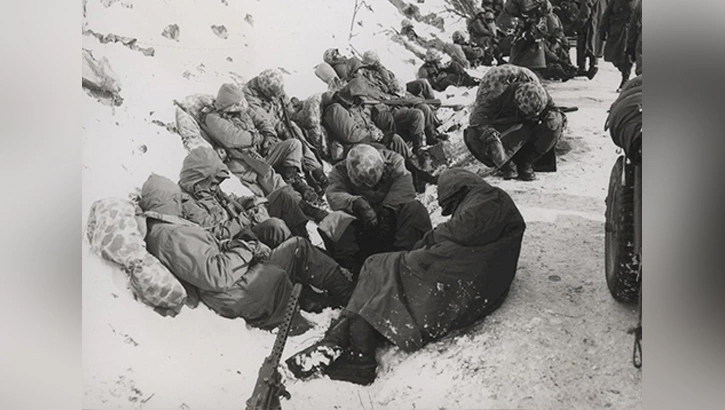
A november közepén tartó időjárás az enyhéből hirtelen csapott át csípős hidegbe, a tél ezzel pedig beszállt a háborúba. Az amerikai katonák rosszul és hiányosan felszereltek voltak olyan extrém hőmérsékletekre, mint amikor a napközbeni 20 fokból estére 10, majd később -20 fok is lett. Megdöbbentőnek tűnhet, de a katonáknak a leharcolt állapotban lévő bakancsukon és egyenruha szettjükön kívülcsak régi típusú hosszúkabátjuk meg fél takarójuk volt. A parancsnokok ugyan viharos sebességgel kértek megfelelő téli ellátmányt a katonák számára (téliparkákat, vastag gyapjúzoknikat, meleg alsóneműt, melegítőberendezéseket és meleg ételt), de sokszor előfordult, hogy az amerikai gyalogosok az élelmiszer fejadagokat dugták be a ruházatuk alá azért, hogy a konzerv ne fagyjon ehetetlenre a zord időjárási körülményeknek köszönhetően. Nagy számban fogytak az édességek is, hogy az energiaszintje megmaradjon az embereknek.
Dacára annak, hogy az amerikai katonák milyen gondokkal küzdöttek, Herbert B. Powell ezredesnek a legnagyobb gondja az volt, hogy minél hamarabb a Yalu folyóhoz érjen, hogy végre belehugyozhasson. Ezt a nem túl kedves rítust emberünk aztán 1950 november 21-én végre is hajtotta.
LÉGIERŐ:
A koreai háború légi hadjárata nagyrészt három fő szerepkör köré összpontosult: A légi fölény/megfigyelés, a stratégiai bombázás és a közeli légi támogatás. A Koreai Népi Demokratikus Köztársaság (KNDK) 1950. június 25-i inváziójának meglepetésszerűségétől és erejétől meglepődve a Koreai Köztársaság (ROK) erői és amerikai tanácsadóik kezdetben zavaros visszavonulást hajtottak végre a félsziget délkeleti része felé. Az invázió kezdeti sokkja azonban hamarosan összehangolt védekezésbe csapott át Puszan körül. A stabilizáció szempontjából döntő fontosságú szerepet játszottak a Dél-Koreán belül és a Japánban állomásozó légi eszközök. A KNDK légiereje feletti légi fölényt az amerikai és dél-koreai erők egy hónapon belül kivívták, ez a légi fölény pedig újra megnyitotta a vitát a légi erő további alkalmazásáról. Az USAF vezetése a légi fölény megteremtését és fenntartását, a kommunista erők mozgásának lelassítását vagy megállítását, valamint a kommunista hadigépezet erejének tompítását célzó stratégiai bombázásokat támogatta. Azt illetően a vezérkarban sosem sikerült konszenzusra jutni, hogy melyik légitaktikának adjanak prioritást, ezek alkalmazását mindig a háború aktuális szakaszának követelményeihez igazították.

"F-86 Sabre repülők az 51. vadászrepülő-elhárító repülőszázad 'Checkertails' kötelékében harcra készülnek a koreai hadműveletek a dél-koreai Suwon légibázison" (Egyesült Államok légiereje 1950-1953).

A haditengerészet AD-3-as zuhanóbombázója kihátrál a zuhanásból, miután egy 2000 fontos bombát dobott le egy híd koreai oldalára egy hídátkelőhelyen Sinuijunál, Mandzsúriában, a Yalu folyónál átívelő hídon. Megjegyzés: légvédelmi ágyúállás a folyó mindkét oldalán"
(Egyesült Államok haditengerészete 1950).
A legtöbb légi fölényért folytatott küzdelem - mind a dugattyús- és sugárhajtású, mind a sugárhajtású repülőgépek közötti - a KNDK és a KNK (Kínai NépKöztársaság) északnyugati határa (azaz a Yalu folyó) közelében zajlott. Ezt a régiót - amelyet általában a Sárga-tenger, a Ch'ongch'on folyó és a Sui-ho víztározó határol - MiG Alley néven ismerték. A kommunista erők a közeli bázisaik, a koncentrált légvédelem és az aktív harci területhez való közelség miatt megnövekedett repülési idők előnyeit élvezték, ezzel szemben az Egyesült Nemzetek erőinek a távolabbi légi bázisok miatt korlátozott volt a veszteglési idejük. A korlátozott, körülbelül 20 perces járőrözési idő gyakorlatilag azt jelentette, hogy a légi fölény helyreállítására és fenntartására szánt ENSZ erőfeszítések nagy része védelmi jellegű feladatokra korlátozódott, a légtérben járőrözve vagy a kommunisták betörő repüléseire reagálva. A kommunista erők azon törekvéseit, hogy az 1950 végén és 1951-ben a kínaiak által irányított offenzívákkal együtt terjeszkedjenek, az ENSZ légitámadásai agresszívan és sikerrel szétzúzták.
Az ENSZ légi fölényének helyreállításához jelentősen hozzájárultak a KNK légterébe történő behatoló repülések is. Hivatalosan az UNC megtiltotta a Jalu folyótól északra működő kommunista repülőgépek üldözését, a hadszíntéren azonban ezt a korlátozást gyakran figyelmen kívül hagyták, és az ENSZ légiereje "csendben" üldözte a szovjet/ KNDK/CCF repülőgépeket Mandzsúrián belül. Jelentős járőzőzés folyt a mandzsúriai légtérben a lehetséges célpontok után, és támadták a KNK légibázisait valamint légvédelmét. Kevés MiG-et figyeltek meg az északi határvidéken - különösen a MiG Alley-n - kívül, az 1951-es ENSZ romboló küldetéseket követően. Az ENSZ légi fölényét, amelyet kezdetben a számbeli és kiképzési egyensúlyhiány miatt nyertek el, a jobb kiképzés, a nagyobb tapasztalat és az agresszívabb pilóták kombinációja révén állították vissza és tartották fenn.
UTÁNPÓTLÁSI VONALAK ÉS ÉLELMISZER:
A légiszállítású katonáknál alap lőszeradag és 3 napi élelmiszer fejadag, a vízi szállítású katonáknál 2 alap lőszeradag és 15 napi élelmiszer fejadag volt, ez utóbbinál 5 napi adag a katonáknál, 10 pedig a hadosztály utánpótlását ellátó egységnél volt megtalálható. A 8. Hadosztály felelt azért, hogy a katonák mindegyike 15 napon belül megkapja a következő adag utánpótlást. A sebesültek végleges elszállásolása Japánban, Fukuokában történt, a súlyos sérülteket pedig légimentéssel vitték ki, ha éppen volt elérhető repülő a feladatra. Ezek a feladatkörök jelentősen csökkentették a 8. Hadsereg működési hatékonyságát, holott már amúgyis szenvedtek a megfelelően kiképzett katonák valamint a felszerelés hiányától. Ezt még tetézte, hogy 1950 októbere után az alapvetően védelmi feladatokra berendezkedett hadsereg szerepkörét támadóra változtatták meg, valamint a számukra ellátmányt szállító hajók elsődleges feladata inkább az 1. Tengerészgyalogos hadosztály és a 7. gyalogos hadosztály partraszállítása lett. Az ellátmányok utánpótlását ez hetekig olyan mértékben akadályozta, hogy az előírt tárolt lőszermennyiség valamint az élelmiszer fejadagok a kritikus szint alá süllyedtek több helyen is, néhány helyen napi 1 étkezésre volt már csak lehetőség a katonáknak. Az utánpótlás megszervezése nagyjából hasonló nehézségeket okozott az amerikaiaknak, mint a kínaiaknak, sőt, a logisztika megszervezését amerikai oldalon csak nehezítette a kínai önkéntesek hadbalépése 1951 elején.
Az amerikai tüzérség kapacitása szinte kimeríthetetlen volt, a lőszert pedig olyan ütemben lőtték, hogyha az NKPA ilyen tempóban vezette volna le a tüzérségi támadásait, nem egészen 2 hét alatt kifogytak volna minden tüzérségi lövedékből.
Felhasznált forrásanyag:
- Russel Spurr: Enter the Dragon
- https://dpaa-mil.sites.crmforce.mil/dpaaFamWebInKoreanAirBattles
2024. február 7., szerda
Zsámbéki rakétabázis rendezvénynapok

Ahogyan azt megszokhattátok, idén is találkozhattok velünk Zsámbékon, az alábbi időpontok valamelyikén. Sok újdonsággal készülünk az idén, bővül a bázishelyünk, és tervben van egy kisebb kültéri múzeum kialakítása is a jelenlegi helyen! Amint lesz információnk a zsámbékon kívüli meghívásainkról, természetesen itt és az Instagram oldalunkon is közzétesszük őket!
ENG: Like in every year, you can also meet us again this year in Zsámbék, on one of the following dates. We have a lot of new things in store this year, we are expanding our base and we are planning to build a small outdoor museum in our current location! As soon as we have information about our invitations outside of the Zsámbék, we will of course post them here and on our Instagram page!
2024. január 28., vasárnap
Korean War: State of the 3 armies in 1950, People's Republic of China

Before we dive into the various battles of the Korean War and the processes that determined them, let's take a look at the level of development and morale of the three different armies in 1950.
PEOPLE'S REPUBLIC OF CHINA
On 15 July 1950, the People's Liberation Army numbered 5,138,756, less than half of which were actual, deployable and properly trained personnel. The main combat units in the 4 different Army Groups were fully manned, but the equipment and manpower training varied throughout. The local militias and technical personnel accounted for another 2.6 million or so personnel, so for the most part the PVA looked like this, as described by General Peng Dehuai: "We have a fat man who we urgently need to put on a diet". The root of the problem lay in the fact that the collapse of the Nationalists and the end of the civil war came much more quickly than anyone in the Communist high command could have hoped. In the great rush to victory, the Communists welcomed anyone willing to take up arms for their cause, including many people who had no qualifications whatsoever for the particular position for which they were being recruited. As a result, junior officers and warrant officers became very scarce, and the vacancies were usually filled by the most incompetent individuals possible. In the last two years of the civil war, the NRA collapsed so rapidly that the communists took 2.25 million (!!!) prisoners of war or defected soldiers in this period alone. For obvious reasons the PLA was forced to recruit these nationalist soldiers for several reasons: one was to make up for their own heavy losses, and the other was the fear that they might desert en masse and join the anti-communist resistance in the rural regions, which even then was showing an activity in large areas that would have been difficult to ignore.

Military service in the People's Liberation Army was a step up from the armies of all previous regimes (Warlords, NRA). Here, even if a soldier did not earn much (the Chinese silver yuan equivalent to 41 cents, which was much less prone to inflation than the gold yuan introduced by the Kuomintang in 1948), he was paid his monthly salary regularly, and unlike the Kuomintang officers, PLA officers did not sell their pay and ammunition to increase their own wealth. Abuse and corporal punishment were not only unheard of, but they were banned. Soldiers were regularly given uniforms when they needed to change, as well as free soap and free access to laundry facilities and even barber shops. Despite this, the Chinese army that was about to leave for Korea needed urgent modifications in certain areas. One of these was the introduction of a limit on conscription, because at that time the period of military service was 'indefinite', so desertions were on the increase. Officers were also reluctant to let their soldiers return home to get married for fear of them not coming back.
The other discouraging factor was the state of the armament and the machinery, of which everyone in the high command was aware. By the end of the second phase of the civil war, the communist forces had the following:
- 2,000,000 rifles
- 250,000+ machine guns
- 55,000 artillery guns
- 622 tanks
- 651 armoured vehicles
- 134 aircraft
- 122 warships
and a lot of equipment left behind by the Japanese. The numbers can be a little deceptive: most of this equipment was junk in the truest sense of the word, either because it was so worn out or because there was nowhere to get spare parts. Technicians all over China were dismantling vehicles to maintain some level of departmental supply, and transport in the military sense was non-existent.
Logistics, communications, electronic equipment and medical care existed at an utterly primitive level, and ammunition stocks throughout the country were at desperately low levels, as the current industrial capacity was unable to replace the ever-aging and thus deteriorating ammunition. Although a small number of machines for weapons production were provided by the Soviet Union, even the limited production they provided would have to wait 2-3 years. For example, they could not even start to produce heavy artillery batteries until they could produce enough steel, and they only received such armament from the Soviets essentially in the last year of the Korean War, but by then it had essentially no effect on the outcome of the war.
INFANTRY:


They also paid particular attention to camouflage and reconnaissance of enemy forces, moving under cover of night while UN forces rested, and resting only during the day. Unlike the US troops, the Chinese commanders were very familiar with the Korean terrain, as long before the war started there were groups of troops disguised as, for example, railway support personnel, which made it easy for them to carry out the necessary reconnaissance, draw maps and record any information that would later be of use to them. Not only before the war, but also afterwards, there were PVA infiltration units that sometimes spent several days behind enemy lines, testing the nerves of even the most hardened veteran. There was also the example of the 116th PVA Division, 300(!!!) metres in front of the 3 platoons of the 9km deep American defence line at the Imjin River, which had built a complete underground bunker network, practically deploying an entire army, completely invisible to the defenders. When the surface attack was launched, in parallel, the units moving underground easily cut through the American defences and successfully broke through.


EQUIPMENT:
The PVA soldiers were relatively well dressed, at least as far as ease of movement in the field was concerned. Unfortunately, the divisions that were hastily thrown over did not have adequate winter gear, so rubber-soled summer shoes or lightweight winter clothing led directly to thousands of Chinese soldiers freezing to death in Korea due to the extreme cold. The small arms problem mentioned above also occurred here, it was common for only 800 men per regiment to be supplied with weapons (a regiment in the PVA was 3,000 men), the rest either being supplied with hand grenades only or with nothing at all. As a result, many soldiers had to wait for their nearest comrade to fall to pick up their weapons...


AIRFORCE:

A few days after the Chinese People's Volunteers (PVA) crossed the Yalu River, something has been happened what the UN command feared the most: the Beijing leadership began to develop an air war plan for Korea. During the almost three years of the war, the communists, despite their relatively large aircraft fleet, had only very limited air support for their ground operations. It was also abundantly clear to the Joint Chiefs that the PVA soldiers were at a considerable disadvantage on the ground, because of almost total American air superiority, and the Chinese had only that ammount of aircraft, which they could use only for pre-planned, ambush-like attacks. The Chinese pilots would need plenty of time for further training, but there was no time this, so it was decided that the best way to learn the skills needed for air combat could be obtained during a real dogfight. In October 1950, the PLA Air Force consisted of two fighter divisions, a bomber regiment and an attack regiment.
One of the biggest challenges the Chinese Air Force faced in preparing for the Korean intervention was the construction of airfields. With PVA troops having recaptured much of the lost territory of North Korea by mid-December 1950, Chinese military leaders began looking for airfields or land that could be built or repaired to launch a full-scale air offensive against UN forces. China's air war plan called for 12 air regiments, or about 350 aircraft, to be deployed in Korea by April 1951. However, to implement such a plan required the construction of airfields in North Korea suitable for jet aircraft. However, the air superiority demonstrated by the UN and the freezing weather thwarted the Chinese calculations. After several months of trying, the Chinese were unable to find or build an airport that would meet their needs. Negotiations with Stalin resulted in help from the Soviet Air Force, but due to a shortage of technical personnel and equipment, some of the airfields were eventually built by NKPA technicians. The fact that the PVA troops had suffered heavy losses on the battlefield in February 1951 also played a role, so the withdrawn 38th, 39th and 42nd Army Groups were ordered to rest instead, and the manpower to build the required number of airfields was not yet available.

Wang Hai, ace of the Korean War, shot down 9 US planes with his MiG
By the end of May 1951, however, after mobilising sufficient manpower and raw materials, the Chinese had finally completed the planned airfields at Sunan, Yongyu, Namyonni and Pyongyang. This caused considerable alarm at the UN, naturally making these airstrips a primary target. Despite the Chinese mobilising 11 regiments of air defence troops and equipment, and the Soviets 8, the airfields were unable to defend themselves against the bombers of the UN troops (many airfields, associated factories and other industrial complexes were destroyed by US bombing), and even more valuable targets than the airfields were left totally or partially unprotected. This finally sealed the entry of the Chinese Air Force into the war, which had been planned for that date, and the leaders again postponed the event until 21 September 1951, and in December 1951 finally put aside the plan for air support of ground operations and concentrated on defence. The Soviet air force did help out at the Yalu River, but even they could not provide a complete defence, and American fighter planes raided the area successfully. As a result, the Chinese could not use airfields in North Korea, relying solely on their short-range MiG-15s, which limited the Chinese aircraft's area of operations to a 150-mile radius from the airbase nearest the Yalu.
Let us also say a few words about the use of bombers. The Americans tried as much as possible to limit the escalation of the war, and like the Soviet & Chinese forces, they severely limited the number of bombings and avoided any situation that would target civilian areas or objects whose destruction would be unnecessary. As a result, in March 1952, the bombers were relieved of further missions in Korea, and the North Korean leadership, while wanting more aggressive action against the Americans, Moscow and China concentrated solely on defensive tasks, fearing a further escalation of the war.
Although the war helped the Chinese to heal their scars from past humiliations at the hands of the Western powers, and strengthened the Communist regime's grip on the people in the early years of the People's Republic of China, China's partnership with Moscow was an absolute but uncomfortable one. Chinese leaders expected unconditional Soviet support from an alliance with Moscow based on shared values and goals, but Stalin withheld promised air support during the critical period of 1950-1951, leaving China to launch military operations in Korea without full air cover. When the guns finally fell silent on the Korean peninsula, the Chinese realised that they had not only suffered heavy physical losses in the conflict, but also found themselves with a huge war debt to the Soviet Union, totalling some $650 million. These facts foreshadowed the difficulties that the Chinese economy would face in the years to come.
The experience of the Korean War painted the Soviet Union as an unreliable ally for the Chinese, and over time China severed this relationship with its former ally, placing greater emphasis on self-sufficiency as a pillar of Chinese national security.
ARMORED UNITS:


Tanks generally played a supporting role during the Korean War, mainly as mobile artillery, because the mountainous terrain rarely allowed place for armoured battles. China claimed to have destroyed some US tanks towards the end of the war. In total, however, the US Army recorded only 119 tank vs. tank engagements, and according to official reports, only 38 US tanks were lost in the conflict. Of course, the losses on both sides were much higher than this, but this was more due to the various missiles, artillery, mines or other devices.
Although tanks sometimes provided useful artillery support for infantry in all three armies, they were relatively rare in an army which consisted of mostly light infantry.
COMMUNICATIONS:
Unfortunately, the PLA could never build up a radio structure like the NKPA, the sad reality was that the Chinese commanders were happy if they could maintain their radio communications at battalion level. They replaced the lack of structural development with messengers, lantern-whistles or even flag signals. Since the Chinese army had many shortcomings (their own revolutionaries in 1949 could not even use the English toilet in many places, let alone replace a radio part themselves, and this is not meant as a demotion of the PLA/PVA, which I respect, but as a fact! ), so for example, in the aforementioned posts, nationalist soldiers who had defected to them in the civil war or were captive-operated the communication posts with one of the above-mentioned signalling systems.

SUPPLY LINES AND FOOD:
Because of the long supply lines, each Chinese soldier could carry 3kg of millet and 12pcs of hard biscuits per person in a sausage-shaped bag wrapped around himself. This was enough rations for about a week. After a while, the Americans realised this and let the PVA soldiers exhaust their reserves, then went on the offensive. In many cases, the Chinese were forced to leave the quickly gained territory as quick as they have captured it. To avoid attracting attention during the day, the cooks in the camp kitchens always started cooking at 3 a.m., under thick tent sheets. If this operation had been carried out during the day, it would have provided an excellent target for American aircraft because of the smoke emitted, even if it was quickly extinguished, but at night the reconnaissance aircraft had almost no chance of identifying the Chinese troops camped on the mainland. The US troops thus kept a wary eye on the roads and the barren hillsides, but the PVA troops moved almost exclusively at night, cleaning weapons under cover of tent flaps and cutting through open ground only when there were really no other options left. Due to logistical problems, supplies (food, ammunition, other equipment) could only be delivered to the combat troops by animals suitable for malting.

REFERENCES I HAVE USED FOR THIS ARTICLE:
- Russel Spurr: Enter the Dragon
- Zhang Xiaoming professor's article https://journals.lib.unb.ca/index.php/jcs/article/view/368/582
- Diary of Centurion's article https://zhuanlan.zhihu.com/p/374704621
- Sohu.com's article https://www.sohu.com/a/509931187_120099904
- https://zhuanlan.zhihu.com/p/355639636
- Hsu Chung-mao's article https://www.thinkchina.sg/korean-war-first-large-scale-war-between-china-and-us-photo-story
- http://www.plapic.com.cn/jfjhb/wqhg/2020/202010yk/jnzgrmzyjkmyccgzz70zn_212151/9926658.html
2024. január 22., hétfő
Feliratkozás:
Bejegyzések (Atom)

-
 Idén is megrendezésre kerül a Kenyérzsák túra, azonban immáron nyitott formában, nem csak hagyományőrzőknek! Akit érdekel az esemény, az alá...
 -
 One of our objectives for this year 2023 is to start to describe in more detail the communist formations that participated in the period 19...
 -
 Before we dive into the various battles of the Korean War and the processes that determined them, let's take a look at the level of de...